

Introduction
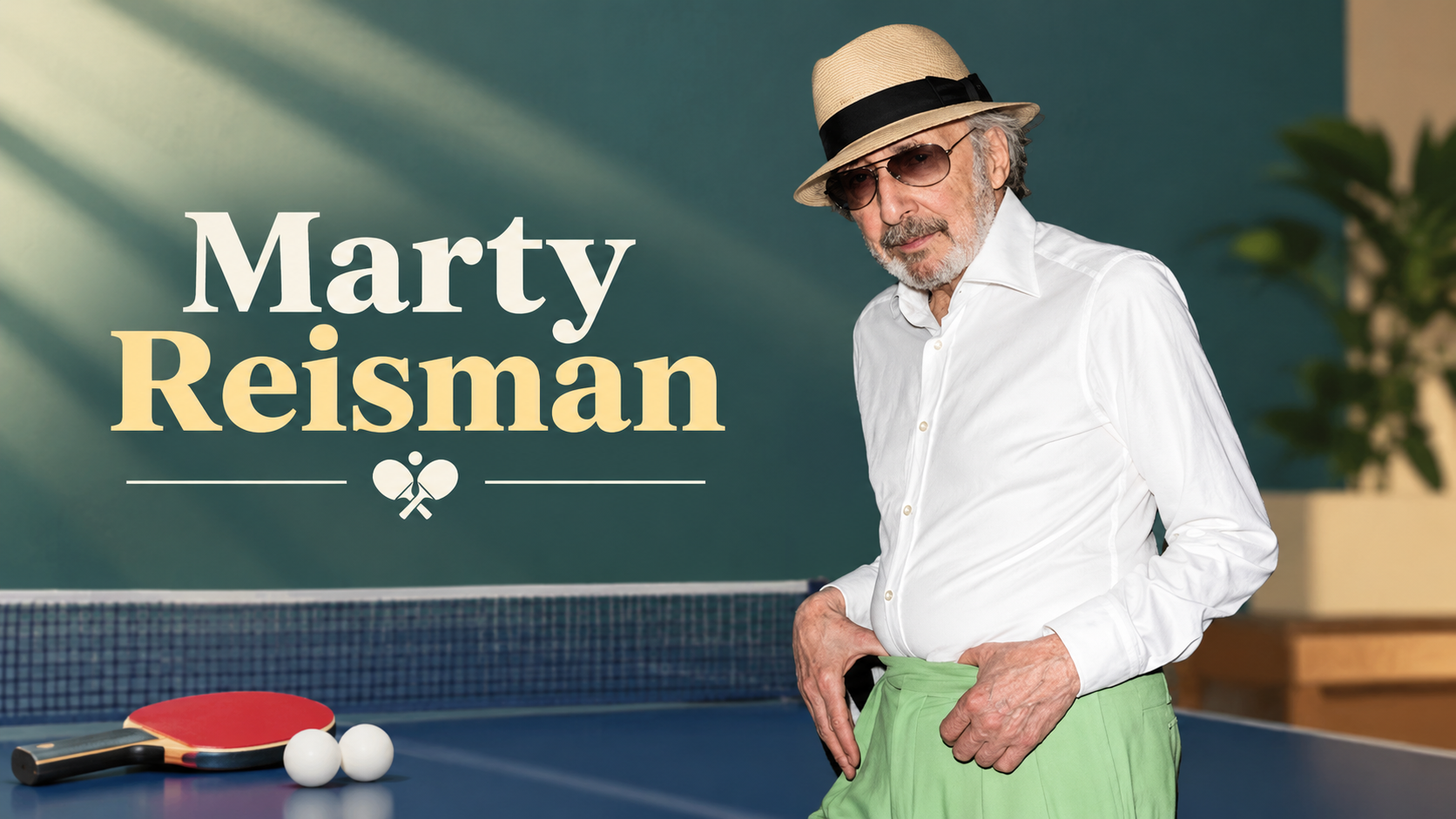
Marty Reisman was one of the most memorable figures in American table tennis. Born and raised in New York City, he turned a childhood interest in the game into a career that lasted for more than five decades. He became known for his quick playing style, confidence, money matches, and strong attachment to traditional hardbat table tennis.
Reisman was also an entertainer who knew how to keep an audience interested. He performed exhibitions, appeared on television, wrote an autobiography, and developed a larger-than-life personality around his career. Years after his death, his story reached a new generation through Marty Supreme, the 2025 film starring Timothée Chalamet, which was loosely inspired by his life.
Marty Reisman Quick Facts
| Detail | Information |
|---|---|
| Full Name | Martin Reisman |
| Born | February 1, 1930 |
| Birthplace | Manhattan, New York |
| Nationality | American |
| Nickname | The Needle |
| Sport | Table Tennis |
| Major Titles | 22 |
| U.S. Singles Titles | 1958, 1960 |
| Book | The Money Player |
| Died | December 7, 2012 |
| Age at Death | 82 |
Early Life and Family
Marty Reisman was born on February 1, 1930, in Manhattan to Morris and Sarah Reisman, Russian Jewish immigrants. He grew up on New York’s Lower East Side with his older brother David. His father worked as a cab driver, and gambling was also part of the family environment, something that later became an interesting connection to Marty’s own career.
Reisman discovered table tennis when he was young and gradually became serious about the game. He spent a great deal of time playing at the Educational Alliance on East Broadway, where he developed the skills that eventually made him a national champion. New York’s table tennis scene gave him plenty of chances to practice and compete against more experienced players.
How Marty Reisman Started Playing Table Tennis
Table tennis was already popular in New York when Reisman was growing up. The game was relatively inexpensive and could be played in clubs, recreation centers, and community spaces. For a young player like Reisman, this created an environment where he could play frequently and improve quickly.
What started as a simple pastime eventually became a serious ambition for Reisman. He became increasingly competitive and began testing himself against stronger players, while also realizing that his personality could give him an advantage. His confidence and psychological approach were especially noticeable in informal matches, where reading an opponent could matter almost as much as technique. A similar sense of dedication can be seen in the journey of British diver Andrea Spendolini-Sirieix, who also developed from an early interest in her sport into international competition.
Marty Reisman’s Table Tennis Career
Reisman’s competitive career developed during a very different era of table tennis. Hardbat rackets were common, international travel was more difficult, and professional opportunities were nowhere near what they are for elite athletes today. Players often had to create their own opportunities through tournaments, exhibitions, and private matches.
Over his long career, Reisman won 22 major titles, including two U.S. Opens and a British Open. He also earned five bronze medals at the World Table Tennis Championships. His results established him as a serious champion and not simply an entertainer who happened to play table tennis.
World Championship Success
Reisman earned his first World Championship medal in 1948 as part of the U.S. men’s team. A year later in Stockholm, he added three more bronze medals, including one in men’s singles. He later won another bronze medal in men’s doubles at the 1952 championships in Bombay.
The 1952 tournament was particularly interesting because Reisman faced Japan’s Hiroji Satoh, one of the early players to use a sponge racket. The new equipment allowed for more speed and spin, while Reisman preferred the older hardbat style. Their encounter represented the changes taking place in international table tennis at the time.
Marty Reisman’s Playing Style
Reisman developed his game around the traditional hardbat racket. Instead of relying heavily on the extreme speed and spin associated with modern sponge equipment, his style depended on timing, placement, control, quick reactions, and reading what his opponent was trying to do.
His approach also involved a strong psychological element. Reisman liked to understand the person on the other side of the table and could use conversation, confidence, or humor to affect the atmosphere of a match. This combination of technique and personality helped make his matches distinctive.
Marty Reisman and Hardbat Table Tennis
Hardbat table tennis uses traditional rackets covered with relatively thin pimpled rubber and without the thick sponge layers found on modern rackets. The equipment produces less speed and spin, which places greater emphasis on control, timing, placement, and patience.
Reisman remained loyal to the style even after sponge rackets became the standard. He believed hardbat table tennis preserved a different kind of tactical battle between players. His support for the older style eventually became one of the most recognizable parts of his sporting identity.
Marty Reisman the Hustler
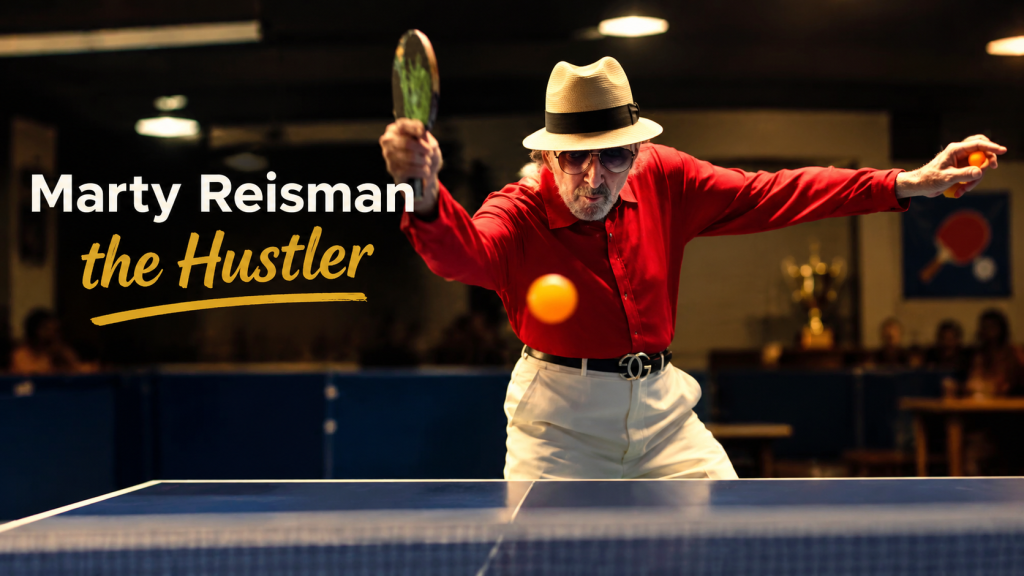
Money matches played a major role in Reisman’s reputation. In New York, he became known for challenging opponents to games for cash and using psychology to his advantage. He understood how confidence could influence an opponent before a match even began.
Some of the stories surrounding his hustling career became legendary, while later accounts have pointed out that Reisman was also an enthusiastic storyteller who sometimes exaggerated details. Even with that uncertainty, his reputation as a money player remained an important part of his public image.
Marty Reisman and Gambling
Gambling was familiar to Reisman from an early age, and it became connected with his table tennis career. One famous story describes Reisman trying to place a large bet on himself as a teenager at a tournament in Detroit. He reportedly handed the money to the wrong person and ended up in trouble with tournament officials.
Stories like this became part of the Reisman legend. He openly talked about money, betting, and competition throughout his career, and these experiences later became some of the most entertaining parts of his autobiography.
Marty Reisman and the Harlem Globetrotters
Reisman discovered that his table tennis skills could also work as entertainment. He and fellow player Douglas Cartland performed exhibitions connected with the Harlem Globetrotters, combining genuine table tennis ability with comedy and unusual tricks.
These performances allowed Reisman to reach audiences outside traditional tournaments. He understood that table tennis could attract attention when it was presented as a show, and his personality made him particularly comfortable in that role.
Marty Reisman’s Trick Shots
Reisman became known for unusual demonstrations that showed how much control he had over a table tennis ball. One of his most famous tricks involved trying to split an upright cigarette with a ball from across the table.
His trick shots helped him make appearances on popular television programs, including The Tonight Show Starring Johnny Carson and Late Show with David Letterman. These appearances introduced him to people who may never have followed competitive table tennis.
Marty Reisman’s U.S. Championships
Reisman won the U.S. Men’s Singles Championship in 1958 and again in 1960. These victories were important milestones because they confirmed his status as one of the leading American players of his era.
His national titles also showed that his reputation was not based only on money games and exhibitions. Behind the colorful personality was an athlete capable of competing successfully at the highest level of American table tennis.
Marty Reisman’s Riverside Table Tennis Club
In 1958, Reisman purchased Riverside Table Tennis Courts on Manhattan’s Upper West Side. The club became another important part of his life and gave him a place where players could practice and compete.
The venue also attracted people from outside the sport, including actors, writers, and other well-known New Yorkers. It reflected the unusual social world Reisman had created around table tennis and helped keep him connected to the sport long after his strongest competitive years.
The Money Player
In 1974, Reisman published his autobiography, The Money Player. The book explored his childhood, table tennis career, international experiences, money matches, and life as a professional player.
The autobiography is useful because it gives readers Reisman’s own version of his story. At the same time, some of his stories are best viewed alongside independent accounts because he was known for turning his experiences into entertaining stories. The book therefore reveals both the player and the personality behind the legend.
Marty Reisman’s 1997 Championship
One of Reisman’s most impressive later achievements came in 1997. At the age of 67, he won the U.S. National Hardbat Championship, returning to the national spotlight in the style of table tennis he had supported for decades.
The victory was particularly fitting because Reisman had spent much of his later career defending hardbat play. Even after many years away from his competitive prime, he remained capable of winning a national championship and showing why he had become such a respected figure in the sport.
Marty Reisman’s Influence on American Table Tennis
Reisman’s influence was not limited to the medals he won. At a time when table tennis received far less mainstream attention in the United States, he helped make the sport more visible through exhibitions, television appearances, clubs, and his colorful public image.
He also represented an older generation of American players who treated table tennis as both a serious competition and a social activity. His career showed how a player could build a life around the sport even when large professional salaries and major sponsorships were uncommon.
Marty Reisman’s Personality and Personal Life
Marty Reisman was known for his confidence, stylish clothes, hats, jokes, and love of attention. His nickname, “The Needle,” reflected his thin appearance and sharp personality. He also understood how entertainment and personality could make him stand out beyond regular table tennis competition.
Reisman kept his family life more private. He was first married to Geri Falk, and they had a daughter named Debbie. He later married Yoshiko Koshino in 1982, and they remained together until his later years. Most public accounts of Reisman focus on his table tennis career, exhibitions, money matches, and colorful personality.
Marty Reisman’s Death
Marty Reisman died in Manhattan on December 7, 2012, at the age of 82. Reports at the time said that he died from complications involving heart and lung ailments.
By then, he had spent more than six decades connected with table tennis. His career had taken him from New York clubs to international championships, television studios, exhibition stages, and hardbat competitions later in life.
Marty Reisman and Marty Supreme
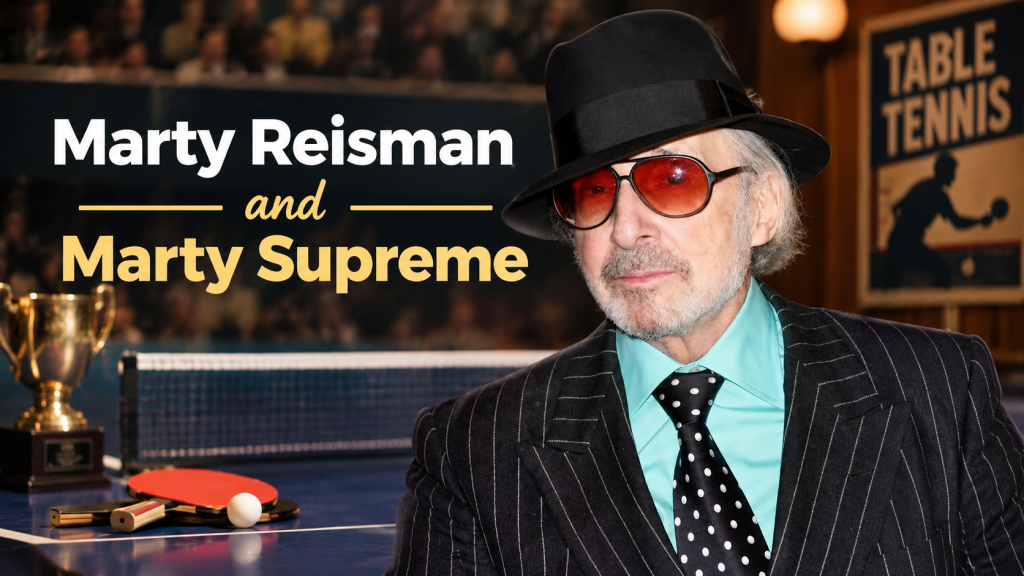
Reisman’s story received renewed attention with Marty Supreme, directed by Josh Safdie and starring Timothée Chalamet. Chalamet plays Marty Mauser, a fictional table tennis player whose character was loosely inspired by Reisman.
The movie is not a direct biography of Reisman. Instead, it takes elements from his life, including the New York table tennis scene, money games, his personality, and his autobiography, and uses them within a fictional story.
Timothée Chalamet and Marty Reisman
Timothée Chalamet’s connection to Reisman comes through his role in Marty Supreme. The actor plays the fictional Marty Mauser rather than portraying every detail of Reisman’s real life.
The film nevertheless introduced many viewers to the real player. For people discovering Reisman through the movie, his actual career provides an interesting contrast because his real achievements included national championships, World Championship medals, exhibitions, and a hardbat title won at age 67.
Was Marty Supreme a True Story?
Marty Supreme is inspired by a real person but should not be treated as a literal retelling of Reisman’s biography. The movie borrows certain ideas from his life, while its characters, relationships, and events were developed for the film.
The real Reisman had enough unusual experiences to make his own story fascinating. His career included international competition, money matches, television appearances, exhibition work, and a long-running defense of hardbat table tennis.
Marty Reisman’s Legacy
Marty Reisman left behind a distinctive place in American table tennis. His 22 major titles, five World Championship bronze medals, U.S. championships, and later hardbat victory form the competitive side of his legacy.
His personality is just as important to his story. He helped turn table tennis into entertainment for wider audiences and remained closely connected with the game throughout his life. The renewed interest created by Marty Supreme has given his unusual career another generation of attention.
Conclusion
Marty Reisman built an unusual career around a sport he had loved since childhood. He became a U.S. champion, World Championship medalist, hardbat advocate, exhibition performer, and author, while developing a personality that helped him stand out from other players. His ability to turn his sporting career into a broader public identity also has some similarities with modern fitness personalities such as Jesse James West, who has built his own career around sport, fitness, and online media.
His connection to Marty Supreme has brought his name back into the spotlight, but the real Marty Reisman’s story remains interesting on its own. His combination of competitive skill, showmanship, ambition, and dedication to table tennis made him one of the most distinctive American players of his generation.
Frequently Asked Questions
Who was Marty Reisman?
Marty Reisman was an American table tennis champion, author, and exhibition performer. He became known for his tournament success, hardbat style, money matches, and colorful personality.
How many titles did Marty Reisman win?
Reisman won 22 major table tennis titles during a career that stretched from 1946 to 2002. He also won the U.S. Men’s Singles Championship twice.
Why was Marty Reisman called “The Needle”?
“The Needle” was Reisman’s nickname, referring to his thin appearance and sharp personality. The name became closely connected with him during his table tennis career.
Was Marty Supreme based on Marty Reisman?
Yes, the film was loosely inspired by Reisman, but it is not a direct biography. Timothée Chalamet plays the fictional character Marty Mauser.
When did Marty Reisman die?
Marty Reisman died on December 7, 2012, in Manhattan, New York. He was 82 years old.

Leave a Reply