


Introduction
Bad Bunny is one of the biggest names in contemporary music and one of the most influential Puerto Rican artists of his generation. Born Benito Antonio Martínez Ocasio on March 10, 1994, he rose from releasing music online to becoming a worldwide superstar whose influence reaches far beyond reggaeton. His career combines Latin trap, reggaeton, Caribbean sounds, experimental production, fashion, acting, and cultural activism. What makes his story particularly interesting is that he has achieved international fame without giving up his Spanish-language identity. Instead of changing his sound to fit the English-speaking market, he made Puerto Rican culture and Spanish-language music central to his global appeal.
Over the years, Bad Bunny has released a series of commercially successful and critically recognized albums, including X 100PRE, YHLQMDLG, El Último Tour del Mundo, Un Verano Sin Ti, Nadie Sabe Lo Que Va a Pasar Mañana, and Debí Tirar Más Fotos. His career entered another historic chapter in 2026 when Debí Tirar Más Fotos won Album of the Year at the Grammy Awards, becoming the first Spanish-language album to receive the ceremony’s top prize. He also headlined the Super Bowl LX halftime show in February 2026, further establishing his position as a global entertainment figure.
Bad Bunny at a Glance
| Detail | Information |
|---|---|
| Full Name | Benito Antonio Martínez Ocasio |
| Stage Name | Bad Bunny |
| Born | March 10, 1994 |
| Age | 32 years old |
| Birthplace | Puerto Rico |
| Nationality | Puerto Rican |
| Profession | Singer, rapper, songwriter and actor |
| Main Genres | Reggaeton, Latin trap and urbano |
| Debut Album | X 100PRE |
| Breakthrough | 2010s |
| Latest Studio Album | Debí Tirar Más Fotos |
| Major 2026 Achievement | Grammy Album of the Year |
Who Is Bad Bunny?
Bad Bunny is the professional name of Benito Antonio Martínez Ocasio, a Puerto Rican singer, rapper, songwriter, and actor. He became associated with the Latin trap movement during the late 2010s before expanding his sound into a much wider range of styles. His deep, unconventional voice and relaxed delivery helped distinguish him from many other artists in the Latin urban scene. Rather than following a single formula, he has continually changed his musical direction, allowing different albums to represent different periods of his artistic life.
His popularity is also connected to his personality and visual identity. Bad Bunny has never presented himself as a conventional pop star, and his fashion choices, public statements, music videos, and performances frequently challenge expectations. He has spoken openly about Puerto Rico, relationships, masculinity, social issues, and cultural identity, which has helped him build a strong connection with younger audiences. His ability to combine mainstream entertainment with a distinctly Puerto Rican perspective has become one of the strongest features of his career.
Bad Bunny Real Name and Early Life
Bad Bunny’s real name is Benito Antonio Martínez Ocasio. He was born on March 10, 1994, in Puerto Rico and grew up on the island. Before international fame, his life was considerably different from the celebrity world surrounding him today. He developed an interest in music while growing up and eventually began exploring different forms of songwriting and recording. His early experiences in Puerto Rico later became an important source of inspiration for his music.
Before becoming a full-time international artist, Benito studied audiovisual communication at the University of Puerto Rico at Arecibo. During this period, he continued working on music and experimenting with his own sound. His early career illustrates how digital platforms changed the traditional route into the music industry. Instead of depending entirely on major-label discovery, he could record, upload, and share his work directly with listeners, allowing his audience to grow organically.
How Did Bad Bunny Become Famous?
Bad Bunny started gaining serious attention around 2016 after releasing music through SoundCloud and other digital channels. His early work attracted people within the growing Latin trap movement, and his song “Soy Peor” became an important early success. His unusual vocal delivery, emotional lyrics, and modern production helped him stand apart from other emerging artists. Collaborations with established musicians then introduced his music to even larger audiences and helped turn him from an underground name into a major Latin artist.
His breakthrough was not based on one song alone. Bad Bunny built momentum through a combination of singles, collaborations, streaming success, and eventually full-length albums. His willingness to experiment also helped him remain interesting to listeners who might otherwise move on to another artist. By the end of the 2010s, he was no longer simply considered a promising Latin trap performer; he had become one of the central figures shaping the direction of Latin urban music.
Bad Bunny Music Career
Bad Bunny’s music career is notable because of how quickly it expanded across international markets. His songs became increasingly popular throughout Latin America, the United States, Spain, and other parts of the world. Instead of treating reggaeton and Latin trap as separate from mainstream pop, he helped bring them directly into the global conversation. His collaborations with artists from different genres also allowed him to reach audiences who were not traditionally listeners of Spanish-language urban music.
Another major part of his success is his approach to albums. Bad Bunny has used each major project to explore a different mood and musical direction. Some releases are heavily influenced by trap, while others focus on reggaeton, Caribbean rhythms, romance, nightlife, nostalgia, or cultural identity. This variety has allowed his discography to develop as more than a collection of singles and has helped establish him as an album-oriented artist.
X 100PRE and Bad Bunny’s Breakthrough
X 100PRE, released in 2018, was Bad Bunny’s debut studio album and a major step forward in his career. The project showed that he could successfully move beyond individual singles and collaborations to create a complete artistic statement. Its mixture of Latin trap, reggaeton, rock, and other influences reflected the creative freedom that would later become a defining feature of his discography.
The album also helped establish the emotional side of Bad Bunny’s music. While many of his songs could be energetic and designed for parties, X 100PRE demonstrated that he could also explore heartbreak, loneliness, relationships, and personal uncertainty. That balance between confidence and vulnerability became one of the reasons audiences connected with him so strongly.
YHLQMDLG and El Último Tour del Mundo
Bad Bunny followed his debut with YHLQMDLG in 2020, an album whose title is commonly understood as “Yo Hago Lo Que Me Da La Gana.” The project reinforced his reputation as an artist who was unwilling to follow conventional expectations. It included some of his most recognizable songs and became another major commercial success, expanding his audience at a time when Latin music was becoming increasingly important internationally.
Later that same year, he released El Último Tour del Mundo. The album continued his experimentation and showed that his success was not dependent on one particular sound. Its arrival also contributed to an important chart milestone, as Bad Bunny demonstrated that an album performed entirely in Spanish could compete directly for the highest positions on the American album charts. These projects helped establish him as a major force rather than a temporary Latin music trend.
Un Verano Sin Ti
Un Verano Sin Ti, released in 2022, became one of the defining albums of Bad Bunny’s career. Its sound was heavily connected to summer, beaches, nightlife, romance, friendship, and Caribbean culture, while still incorporating reggaeton and other Latin styles. Songs such as “Tití Me Preguntó,” “Me Porto Bonito,” “Ojitos Lindos,” and “Moscow Mule” became major international hits and helped the album reach listeners far beyond the traditional Latin music audience.
The album’s success also demonstrated how powerful Bad Bunny had become in the streaming era. Un Verano Sin Ti remained one of the most successful Latin albums ever released and became an important reference point for the global popularity of Spanish-language music. Rather than relying on English-language crossover songs, Bad Bunny allowed the album to remain predominantly Spanish while audiences around the world embraced it.
Nadie Sabe Lo Que Va a Pasar Mañana
In 2023, Bad Bunny released Nadie Sabe Lo Que Va a Pasar Mañana, a project that moved toward a darker and more trap-focused sound. The album felt different from the bright Caribbean atmosphere of Un Verano Sin Ti, showing that Bad Bunny was not interested in simply reproducing his previous success. The title itself reflected the uncertainty and unpredictability surrounding both his personal life and his career.
The project also demonstrated his confidence as an established artist. By this stage, Bad Bunny no longer needed to prove that he could produce successful songs. Instead, he could use a major release to explore sounds that were less commercially obvious. That freedom has become an important part of his artistic identity and explains why his albums often feel different from one another.
Debí Tirar Más Fotos
Debí Tirar Más Fotos became one of the most important chapters of Bad Bunny’s career. Released on January 5, 2025, the album turned strongly toward Puerto Rican culture, memory, identity, and the feeling of looking back at moments that cannot be repeated. Its title, which translates to “I Should Have Taken More Photos,” immediately suggests nostalgia and the importance of preserving memories.
The album combines contemporary production with Puerto Rican musical traditions and includes songs such as “DtMF,” “Baile Inolvidable,” “Nuevayol,” “El Clúb,” and “LO QUE LE PASÓ A HAWAii.” Its cultural focus helped distinguish it from his previous projects, while its commercial success proved that deeply local subject matter could still connect with a worldwide audience. The GRAMMY later described the project as a celebration of Puerto Rican musical traditions and its place in contemporary music.
Bad Bunny’s Historic Grammy Impact
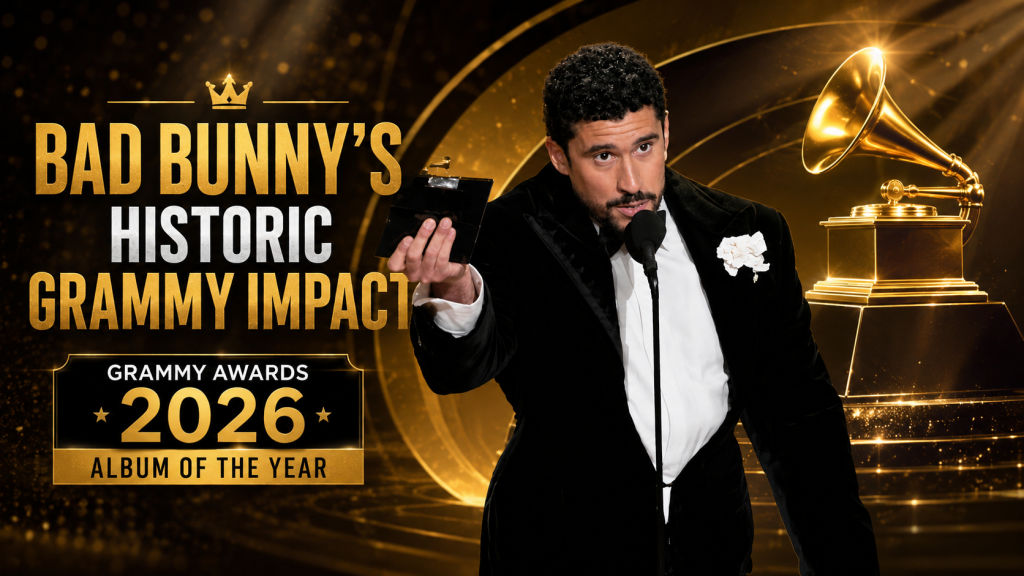
One of the greatest achievements of Bad Bunny’s career came at the 2026 Grammy Awards when Debí Tirar Más Fotos won Album of the Year. The victory was historic because it became the first Spanish-language album to win the ceremony’s top award. The recognition placed Bad Bunny in a new category of global artists whose work can compete at the highest level of the mainstream American music industry while remaining rooted in another language and culture.
The Grammy victory was especially significant because of what the album represented. Rather than changing his musical identity to appeal to a broader English-speaking market, Bad Bunny made Puerto Rico one of the central subjects of the project. His achievement therefore carried cultural importance as well as personal recognition. It demonstrated that Spanish-language music could occupy the most prestigious spaces in an industry historically dominated by English-language releases.
Bad Bunny at the Super Bowl LX
Bad Bunny reached another historic milestone when he performed during the halftime show at Super Bowl LX in February 2026. The performance gave him one of the largest global stages in entertainment and introduced his music to millions of viewers. His set included recognizable songs such as “MONACO,” “BAILE INoLVIDABLE,” “Safaera,” and “VOY A LLeVARTE PA PR,” along with a surprise appearance involving Lady Gaga’s “Die With a Smile.”
The performance was significant beyond its entertainment value because Bad Bunny maintained his Spanish-language identity on one of America’s most internationally visible stages. His appearance showed how far Latin music had moved into the center of mainstream culture. Coming shortly after his Grammy Album of the Year victory, the Super Bowl performance made 2026 a particularly historic year for the Puerto Rican superstar.
Bad Bunny Songs and Biggest Hits
Bad Bunny has built an enormous catalog of songs covering different subjects and musical styles. His most recognized tracks include “Soy Peor,” “MIA,” “Callaíta,” “Safaera,” “Yo Perreo Sola,” “DÁKITI,” “Yonaguni,” “Tití Me Preguntó,” “Me Porto Bonito,” “Ojitos Lindos,” “Moscow Mule,” “MONACO,” and several songs from Debí Tirar Más Fotos. These releases demonstrate how his sound has changed over time while maintaining recognizable elements of his vocal style.
His songs often succeed because they can work in different environments. Some are designed for clubs and parties, while others focus on romance, heartbreak, social commentary, nostalgia, or personal reflection. This range has allowed Bad Bunny to appeal to different generations and audiences. A listener might discover him through a high-energy reggaeton song and later become interested in his more emotional or culturally focused work.
Bad Bunny Albums and Discography
Bad Bunny’s major studio albums form a clear timeline of his artistic evolution. X 100PRE introduced his album-era identity, YHLQMDLG expanded his urban sound, and El Último Tour del Mundo demonstrated his willingness to experiment. Un Verano Sin Ti brought Caribbean and summer influences to an enormous international audience, while Nadie Sabe Lo Que Va a Pasar Mañana returned to a more trap-oriented atmosphere.
Debí Tirar Más Fotos then represented another major shift by placing Puerto Rican history, culture, nostalgia, and musical traditions at the center of the project. Looking across his discography, the most consistent element is change. Bad Bunny has repeatedly avoided staying inside the sound that made his previous album successful, which has helped his career remain unpredictable and culturally relevant.
Bad Bunny Age and Birthday
Bad Bunny was born on March 10, 1994, which makes him 32 years old in 2026. His birthday places him among the generation of artists who experienced the rapid transformation of the music industry through streaming and social media. Unlike earlier performers who often needed years of traditional radio exposure before becoming internationally recognized, Bad Bunny was able to build an audience through digital platforms and online music communities.
His age is also interesting when viewed alongside his achievements. By his early thirties, he had already released multiple internationally successful albums, completed major world tours, earned Grammy recognition, performed at the Super Bowl, and become a major fashion and entertainment figure. His career demonstrates how quickly a modern artist can build a global audience when music, streaming, social media, and cultural identity work together.
Bad Bunny Family and Personal Life
Bad Bunny has generally kept many details of his family life away from the constant attention that comes with international fame. He was raised in Puerto Rico and has spoken about his upbringing and the influence of his home island throughout his career. His connection to family, childhood memories, and Puerto Rican life frequently appears indirectly through the themes and atmosphere of his music.
His personal relationships have also attracted substantial public interest, particularly his widely discussed relationship with model Kendall Jenner. Because Bad Bunny is one of the world’s most famous entertainers, his private life often becomes the subject of speculation. However, not every rumor surrounding his relationships or songs is confirmed, so it is important to distinguish public reporting from fan theories and social media speculation.
Bad Bunny and Kendall Jenner
Bad Bunny and Kendall Jenner became one of the most closely watched celebrity pairings after they were publicly linked in 2023. Their relationship attracted attention because both already had enormous international profiles, and their appearances together quickly became a major topic in entertainment media. Their connection also generated widespread speculation about whether elements of Bad Bunny’s music were inspired by their relationship.
Despite the public interest, Bad Bunny has generally maintained boundaries around his private life. Songs and lyrics are frequently interpreted by fans as references to specific relationships, but an interpretation is not necessarily confirmation. His music often draws from emotions and experiences without providing a literal explanation of who inspired every line, which allows listeners to connect with the songs in their own ways.
Bad Bunny Net Worth

Bad Bunny’s exact net worth is difficult to establish because his private assets, investments, contracts, expenses, and business arrangements are not fully public. Online websites frequently publish specific net-worth figures, but many of those numbers are estimates without enough financial documentation to treat them as confirmed. A more reliable approach is to look at publicly reported earnings, tours, endorsements, and other known sources of income.
His wealth comes from several areas, including music streaming, album releases, concert performances, merchandise, brand partnerships, fashion projects, acting, and other entertainment ventures. His massive touring business has been particularly important. His Debí Tirar Más Fotos World Tour concluded in July 2026 after traveling across multiple continents, further demonstrating the enormous commercial value of his live performances.
Bad Bunny World Tour
The Debí Tirar Más Fotos World Tour became one of the largest tours of Bad Bunny’s career. Beginning in late 2025 and continuing through 2026, the stadium tour took his music to audiences across different regions of the world. The scale of the performances reflected the international demand created by his latest album and the momentum from his Puerto Rico residency.
The tour officially concluded in Brussels on July 22, 2026, bringing an end to a major era of his career. Reports following the conclusion indicated that the tour generated hundreds of millions of dollars and sold more than three million tickets across its scheduled shows. Those figures demonstrate that Bad Bunny’s popularity is no longer limited to streaming platforms or Latin American markets; he has become one of the world’s biggest live performers.
Bad Bunny’s Puerto Rico Residency
Before taking Debí Tirar Más Fotos around the world, Bad Bunny held the “No Me Quiero Ir de Aquí” residency in Puerto Rico during 2025. The residency was especially meaningful because it allowed him to perform an extended series of shows in his home territory rather than treating Puerto Rico as just another stop on an international tour.
The residency also strengthened the connection between Bad Bunny’s music and Puerto Rican culture. It created a local celebration around an artist whose career had become global while reminding audiences that his identity remained deeply connected to the island. The residency became an important bridge between the personal themes of Debí Tirar Más Fotos and the worldwide stadium tour that followed.
Bad Bunny Acting Career
Bad Bunny has expanded his career beyond music by appearing in films and other entertainment projects. His acting credits include roles in movies such as Bullet Train, where he appeared alongside a major Hollywood cast. Moving into acting allowed him to demonstrate another side of his creativity and introduced him to audiences who may not primarily follow Latin music.
His film career also reflects his broader approach to entertainment. Bad Bunny has never limited himself to being only a recording artist. He has explored fashion, acting, professional wrestling, advertising, and other creative fields, making his public identity larger than music alone. As his career develops, acting is likely to remain another area through which he can reach new audiences.
Bad Bunny Fashion and Style
Fashion has become an important part of Bad Bunny’s public image. He regularly experiments with silhouettes, colors, accessories, hairstyles, and traditionally gendered clothing. His willingness to ignore conventional expectations has made him a significant figure in contemporary fashion as well as music.
His style also supports his broader artistic philosophy. Bad Bunny frequently treats clothing as an extension of his music and personality rather than simply a promotional tool. From red-carpet appearances to music videos and concert performances, his visual choices often reinforce the idea that he does not want to fit neatly into a predetermined image of what a Latin male superstar should look like.
Bad Bunny’s Puerto Rican Identity
Puerto Rican identity is one of the strongest themes running through Bad Bunny’s career. His music frequently includes Puerto Rican slang, references, rhythms, locations, memories, and social issues. Rather than treating his culture as something that must be simplified for international audiences, he often expects global listeners to enter his world on its own terms.
This approach has made his success culturally significant. Millions of people who do not speak Spanish have become familiar with Puerto Rican expressions and musical traditions through his work. His international popularity has therefore created a two-way relationship: global audiences discover Puerto Rican culture through his music, while Puerto Rican listeners see elements of their own identity represented on some of the world’s biggest entertainment platforms.
Bad Bunny’s Influence on Latin Music
Bad Bunny has played a major role in changing the international perception of Latin music. Before his rise, Spanish-language artists had already achieved enormous success, but his combination of streaming power, album sales, touring, fashion, and cultural visibility pushed the boundaries even further. He proved that a Spanish-language artist could dominate global conversations without needing to release a large body of English-language music.
His influence can also be seen in the way younger artists approach genre. Bad Bunny helped normalize the idea that reggaeton, trap, Caribbean music, pop, and other sounds can exist together within one artist’s catalog. His willingness to experiment has encouraged listeners to expect change rather than repetition, making him an important figure in the continuing evolution of Latin urban music.
Bad Bunny’s Legacy
Bad Bunny’s legacy is already becoming visible even though his career is still developing. He has helped demonstrate that a global superstar does not need to abandon his original language or cultural identity to achieve international success. His career has opened more space for Spanish-language music at the highest levels of mainstream entertainment and has helped make Latin urban music an even more powerful global force.
His greatest contribution may ultimately be the freedom he has given other artists to experiment. Bad Bunny has shown that reggaeton can coexist with alternative sounds, that fashion can challenge traditional expectations, and that deeply local stories can reach audiences around the world. His Grammy victory, Super Bowl performance, and massive 2025–2026 world tour represent milestones, but his long-term influence will likely be measured by the artists and cultural movements that follow his example.
Conclusion
Bad Bunny has grown from a young Puerto Rican artist sharing music online into one of the most influential entertainers in the world. His success with albums such as X 100PRE, YHLQMDLG, Un Verano Sin Ti, and Debí Tirar Más Fotos has helped redefine the global reach of Spanish-language music. At the same time, his strong connection to Puerto Rico has remained at the heart of his artistic identity.
With a historic Grammy win, a Super Bowl halftime performance, major international tours, and a growing presence in film and fashion, Bad Bunny’s influence continues to expand. His career proves that global success does not require an artist to leave behind their language or culture. Instead, Bad Bunny has made his Puerto Rican identity one of the strongest reasons audiences around the world continue to follow his journey.
Frequently Asked Questions
What is Bad Bunny’s real name?
Bad Bunny’s real name is Benito Antonio Martínez Ocasio. He was born in Puerto Rico on March 10, 1994.
How old is Bad Bunny?
Bad Bunny is 32 years old in 2026. His birthday is March 10.
What is Bad Bunny’s most popular album?
Un Verano Sin Ti is one of Bad Bunny’s most successful albums, while Debí Tirar Más Fotos became another major milestone in his career.
Did Bad Bunny win a Grammy?
Yes. Bad Bunny won Album of the Year at the 2026 Grammy Awards for Debí Tirar Más Fotos.
Did Bad Bunny perform at the Super Bowl?
Yes. Bad Bunny performed at the Super Bowl LX halftime show in 2026, marking another major achievement in his career.

Leave a Reply